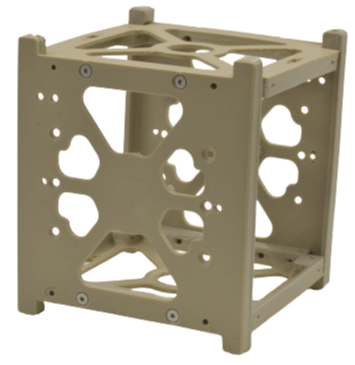
The Orion AM team is thrilled to announce that another set of our printed parts has successfully reached low earth orbit (LEO)!
On Tuesday, our Berlin Moabit neighbors at Exolaunch successfully deployed a new payload aboard the SpaceX Transporter-17 mission. Inside that payload stack is a custom-printed PEEK sample holder that was manufactured by our team here in Berlin.
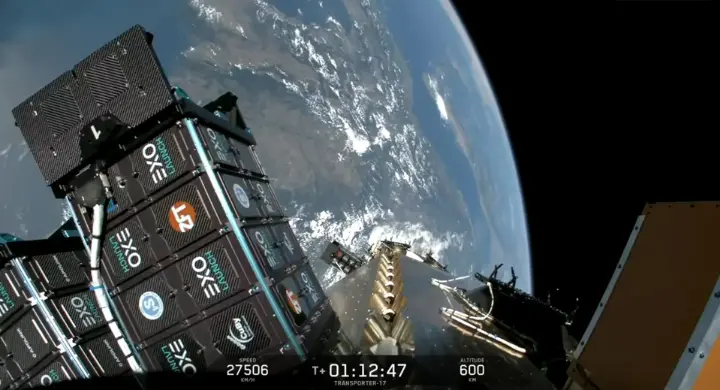
Photo Credit: SpaceX
Advancing Space Resources with ESRIC
Last fall, we supported PhD students at the European Space Resources Innovation Centre (ESRIC), a Luxembourg-based research institute focused on developing space resources and advancing in-situ resource utilization (ISRU), basically, how to manufacture in space. They designed a specialized sample holder to conduct advanced experiments in LEO and approached us for small-series production support of their unique geometry.
Now that the payload is successfully in orbit, it will perform its programmed experiments in the vacuum of space, then transmit the data back to Luxembourg for analysis. We can't wait to read their theses that come out of this work!
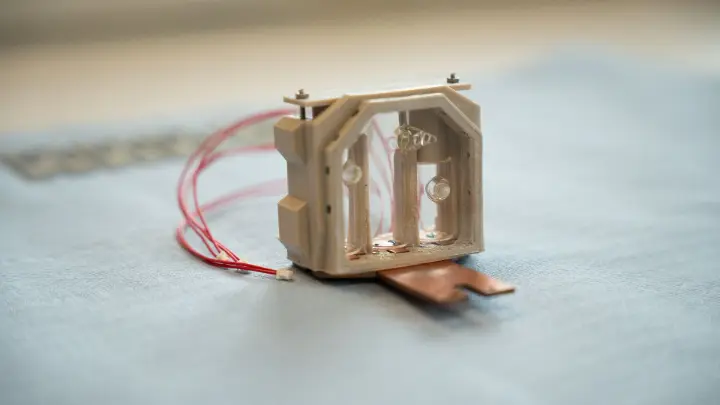 Photo Credit: ESRIC
Our Second Mission to Space
This Transporter-17 mission marks an exciting milestone for us: it is the second time (that we know of!) our 3D-printed parts have been launched into space.
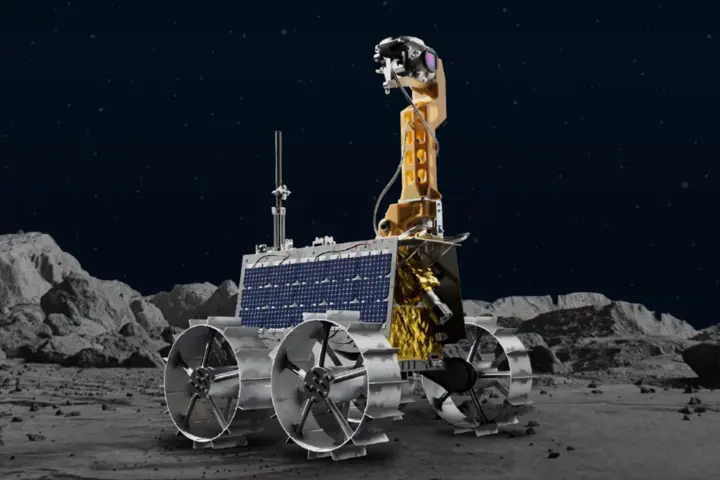
Image credit: ESA/Mohammed Bin Rashid Space Centre
The first time was in 2023, when components we manufactured were launched aboard a SpaceX Falcon 9 rocket as part of the European Space Agency (ESA) supported Emirates Lunar Mission, carrying the Rashid rover. Seeing our technology successfully enter LEO for a second time validates the incredible value-add we see in our additive manufacturing process for aerospace industries.
Why We're Bullish on PEEK for Space Applications
High-performance polymers like PEEK (Polyetheretherketone) sit at the absolute sweet spot for space-ready materials with a combination of extreme properties. They are:
- Highly Durable: Capable of surviving intense mechanical stress during launch vibrations.
- Temperature Resistant: Able to withstand the extreme thermal fluctuations. It's cold up in LEO!
- Chemical Resistant: Impervious to many harsh solvents and fuels.
- Lightweight: Crucial for keeping launch mass (and therefore costs) down.
- Low Outgassing: Essential for ensuring that the vacuum of space doesn't cause the material to release gasses that could blind optical sensors or damage sensitive electronics.
The Orion AM Advantage: Unlocking Polymer Potential
The theoretical benefits of PEEK are exceptional, but they are only unlocked if the final part is structurally flawless. Historically, traditional Additive Manufacturing (AM) has struggled with producing space-grade polymers due to the limitations of internal voids and poor interlayer-bonding, which compromise the material's strength and reliability.
That is exactly where Orion AM sits. We are the toolmakers bridging the gap between advanced materials and advanced manufacturing. After over eight years optimizing our process for high performance polymers, our systems produce fully-dense, isotropic parts that eliminate the weaknesses of traditional 3D printing. We bring the distinct advantages of additive manufacturing (greater geometric freedom and favorable economics for a series of 1) to new materials, ensuring they are ready for the most demanding environments on Earth, and now, off the planet.
Are you developing components for extreme environments? Whether you are building for the deep sea, the factory floor, or Low Earth Orbit, we can help you unlock the power of high performance polymers. We can't wait to hear from you.